Spotting ants in your home is one thing. But seeing winged ants? That tends to stop homeowners in their tracks. If you’ve recently noticed flying or winged ants indoors, it’s natural to wonder: is this just a random occurrence, or is it a sign of something bigger?
In most cases, winged ants inside your home are not random. They’re a strong indicator of a well-established, mature colony nearby or even inside your house.
Let’s break down what this means and what you should do next.
What Are Winged Ants, Exactly?
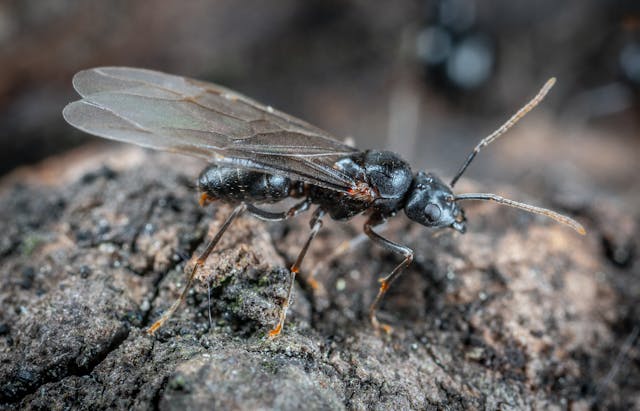
Winged ants, also known as “swarmers” or “alates,” are reproductive members of an ant colony.
Their job is simple:
- Leave the nest
- Mate
- Start new colonies
They are produced only when a colony has reached a certain level of maturity and stability. That’s why their presence matters.
Why Do Winged Ants Appear Indoors?
Winged ants typically emerge during warmer months, especially in spring and early summer. They appear when conditions are right for mating flights:
- Warm temperatures
- Increased humidity
- Stable colony growth
If you’re seeing them inside your home, it usually means one of two things:
The Colony Is Inside Your Home
This is the most concerning scenario.
If winged ants are emerging from:
- Walls
- Ceilings
- Window frames
- Baseboards
…it strongly suggests the colony is already established within your structure.
A Colony Is Very Close to Your Home
Even if the nest isn’t inside, it may be:
- Under your foundation
- Inside nearby wood structures
- In soil close to your home
Winged ants can easily find their way indoors during their flight phase.
Does This Mean the Infestation Is Large?
In most cases, yes. Colonies only produce winged ants when they are mature. That means:
- The colony has been active for a while
- There are enough workers to sustain expansion
- Conditions are favorable for reproduction
This isn’t an early-stage problem. By the time you see swarmers, the colony is already well-developed.
Why This Is a Bigger Concern Than Regular Ants
Seeing a few worker ants can mean they’re simply foraging. However, seeing winged ants suggests something more advanced:
- A fully established colony
- Potential satellite nests
- Increased risk of expansion
If the species is carpenter ants, there may also be structural damage occurring behind the scenes.
Winged Ants vs Termites: Don’t Confuse Them
Many homeowners panic when they see winged insects indoors, fearing termites.
While both ants and termites can have wings, there are key differences:
- Ants have a narrow, pinched waist
- Termites have a thick, straight body
- Ants have bent (elbowed) antennae
- Termites have straight antennae
Correct identification is important because treatment methods differ significantly.
What You Should Do Immediately
If you spot winged ants indoors, don’t ignore it. Here’s what to do:
- Note where they are appearing (walls, windows, ceilings)
- Avoid relying solely on sprays
- Check for other signs like sawdust or hollow wood
- Limit access to food and moisture
Most importantly, treat it as a warning sign, not a one-time incident.
Why Spraying Isn’t Enough
Just like with regular ants, spraying winged ants won’t solve the underlying issue. You might eliminate the ones you see, but:
- The colony remains active
- More swarmers can emerge
- The infestation continues to grow
Because swarmers come from an established colony, the real problem is hidden deeper inside your home.
When to Call a Professional
Winged ants are one of the clearest signs that professional help is needed. Identifying the species
- Locating the main colony and any satellite nests
- Eliminating the queen
- Preventing future infestations
The Risk of Ignoring Winged Ants
Delaying action can lead to:
- Expansion of the colony
- Formation of new nests
- Increased structural damage (especially with carpenter ants)
- Higher treatment costs later
What seems like a one-time sighting can quickly turn into a much larger problem.
So, is finding winged ants inside a sign of a big infestation? In most cases, yes. They indicate that a colony has matured and is actively reproducing, something that doesn’t happen overnight. Ignoring the issue or relying on quick fixes won’t stop the problem at its source. The sooner you act, the easier it is to control.
If you’ve seen winged ants in your home, it’s a clear signal to take the situation seriously. Professional ant control in Toronto can help you identify the extent of the infestation and eliminate it before it spreads further.
At GTA Toronto Pest Control, we specialize in handling advanced infestations, including cases involving winged ants. Our team can assess your home, locate hidden colonies, and provide effective solutions to protect your property long-term.
Don’t wait for the problem to grow. Address it early and with the right approach.